We are a GS1 partner
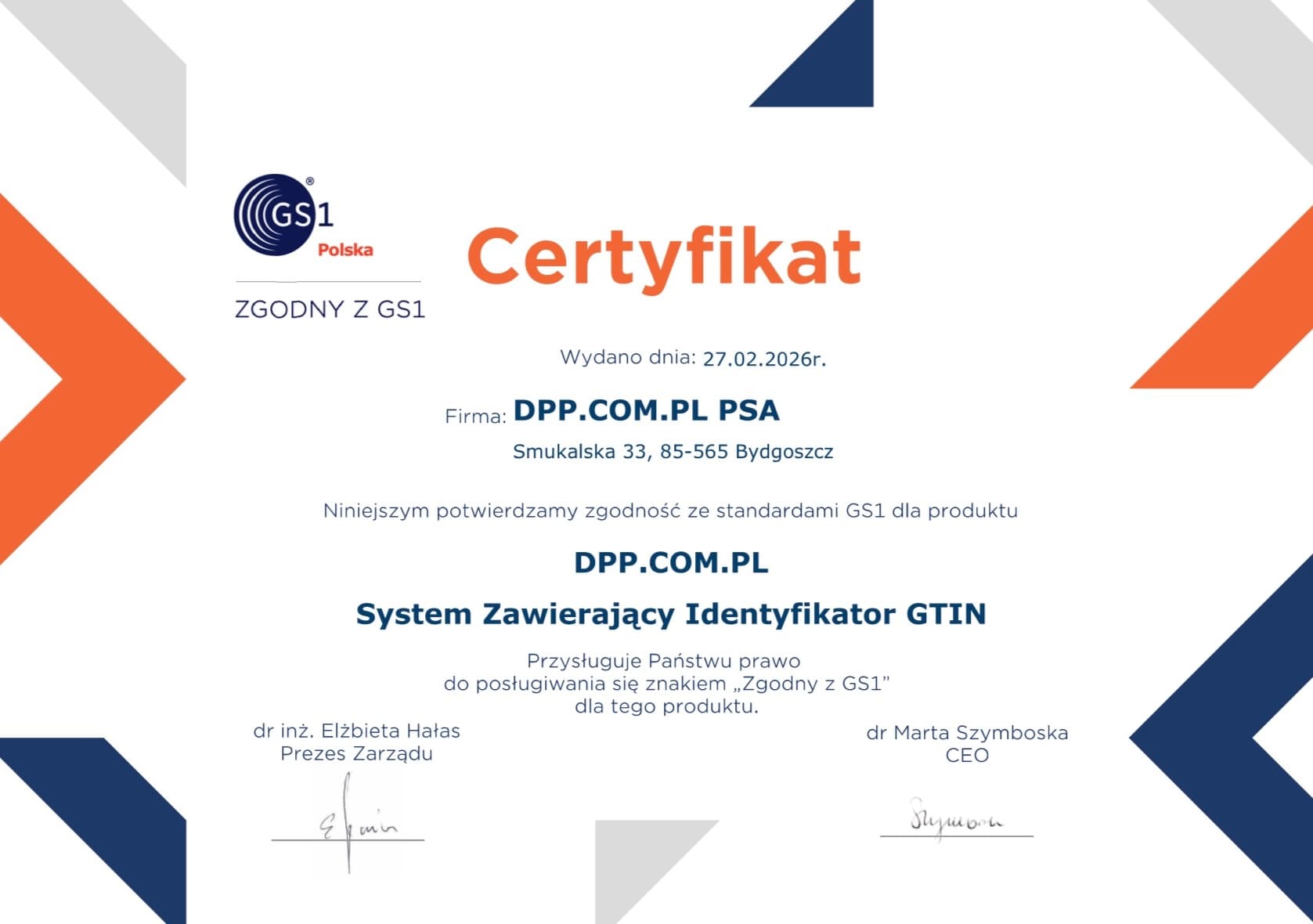
We have received the GS1 Solution Partner certificate — GS1 being the global, neutral standards organisation whose identifiers (GTIN, the barcode, GS1 Digital Link) identify products worldwide. For our customers it means we build the digital product passport on standards that retail, logistics, customs and recyclers already understand — not in a closed, proprietary format.
What GS1 is
Standards the whole world uses
GS1 is a global not-for-profit organisation that develops and maintains the most widely used supply-chain standards — from the barcode to GS1 Digital Link. A few numbers that show the scale.
- 1973
- the year the GS1 barcode standard was created
- 150+
- countries where GS1 operates (over 110 member organisations)
- 2M+
- companies worldwide use GS1 standards
- 50k+
- GS1 system participants in Poland
- 2018
- the year the GS1 Digital Link standard was ratified
- 1×
- GS1 Poland — the only official source of GTIN/EAN codes in Poland
What it means for you
Why the GS1 standard matters
A GS1 partnership is not a badge on a website - it brings concrete benefits for the data in your product passport.
Interoperability
Your product passport is readable and scannable across the whole supply chain — in retail, logistics, at the border and at the recycler — because it builds on the same standards as the rest of the world.
Globally unique identity
GTIN uniquely identifies a trade item globally and can be combined with batch or serial-level identifiers where more granular identification is required.
Aligned with where regulation is heading
ESPR Annex III explicitly lists the GTIN (ISO/IEC 15459-6) or an equivalent identifier among the passport data, and GS1 Digital Link is part of ISO/IEC 18975 - less risk of having to re-engineer everything later.
No vendor lock-in
A passport built on an open standard stays portable — your data is not trapped in a single vendor or a single system.
GS1 Digital Link
One QR code that leads to the passport
GS1 Digital Link turns a product identifier (GTIN) into a web address encoded in a single QR code. This is the standard that makes a digital product passport practical.
GS1 in Europe takes part in the EU’s product-passport work (including the CIRPASS project). The law does not mandate a specific standard: it requires identifiers compliant with ISO/IEC 15459 and data carriers compliant with standards - since 2026 including the harmonised EN 18219 (identifiers) and EN 18220 (data carriers). The QR code or NFC tag is the data carrier; GS1 Digital Link is how the identifier is written into it as a web address.
- The same code works at the checkout and leads a consumer, customs officer or recycler to the product information.
- The content (the passport) can be updated without reprinting packaging — the code stays, the data lives.
- A resolver acts as a “path-finder”, routing the scan to the right data sources.
- A globally unique GTIN, extended with a batch or serial number where needed, ties the passport to the right product model, batch or individual item.
Tool
Got a GS1 code? Check it
We provide a free GS1 code validator — GTIN, GLN and SSCC. Type a number and we’ll show whether it’s a trade item, a location or a logistic unit, and visualise it as a code.
Official sources and materials:GS1 (global)GS1 PolandGS1 Digital LinkGS1 in Europe — DPP